1. Totsukuni no Shōjo / The Girl from the Other Side (Yutaro Kubo, 2022)


Nothing short of a modern anime classic, though bound to appeal to a niche rather than mainstream audience, Yutaro Kubo’s impressive feature debut attains an almost perfect balance between the unconventional style and gloomy content. Part melancholic tone-poem, and part mystery-imbued fantasy of the Victorian Gothic atmosphere, it appears like a soothing soul successor to Oshii’s masterpiece ‘Angel’s Egg’ and Takahata’s magical swan song ‘The Tale of the Princess Kaguya’. Based on Nagabe’s manga previously adapted into a (lovely!) short in 2019, it gently addresses the themes of loneliness, ostracism, surrogate parenthood, the loss of innocence and death, drawing you into its quaint, peculiar world with an irresistible charm. Favoring lyrical mood over puzzling story, ‘The Girl from the Other Side’ rests upon a dreamy, hauntingly poignant score, and a delightful hand-drawn artwork akin to a childhood-favorite picture-book, with Jun Fukuyama’s and Rie Takahashi’s superbly attuned voices breathing life into leading characters.
2. La mort trouble / The Unquiet Death (Claude d’Anna & Férid Boughedir, 1970)


At the time of the film’s release, French writer and journalist Louis Chauvet (1906-1981) described it as ‘a cinematographic treatise on insanity and degradation’ for Le Figaro. And if I were asked to draw parallels with other filmmakers whose work I’m more familiar with, I’d probably say ‘Alain Robbe-Grillet by way of Nikos Papatakis’ or ‘Godard perverted through the prism of Zwartjes’ or ‘Losey’s ‘The Servant’ transmuted by Panic Movement’s anarchic insurgency’, with each comparison meant to be the highest compliment. As brazen as its protagonists – three sisters and their late uncle’s butler, all fucked-up excuses for human beings, ‘The Unquiet Death’ plunges the viewer into a twisted game of shifting power dynamics, exploring gender disparities, class struggle and racial tension in an increasingly radical series of formally daring vignettes that see the quartet emanating dangerous amounts of unnerving energies, anticipating Żuławski’s singular oeuvre. Delightfully scandalous and forcefully liberating, this rarely seen piece of (experimental) cinema redefines the overused ‘acquired taste’ phrase, and makes you want to paint yourself in primary colors and throw eggs at everyone that annoys you at the moment.
3. Le collier perdu de la colombe / The Dove’s Lost Necklace (Nacer Khemir, 1991)


A delightful co-production of Tunisia, France and Italy, ‘The Dove’s Lost Necklace’ is the second part in Nacer Khemir’s ‘Desert Trilogy’ which is deeply rooted in medieval Arabic Romanticism. Chronicling an elliptical search for the (unfathomable) secrets of love, it immerses the viewer in a world of calligraphers, booksellers, cursed princes, and mysterious disappearances, and invites you to observe it through the prism of childlike wonder. Sublimely poetic to its very core, it weaves the soft threads of micro-stories into the tapestry of the main narrative, rich with colors and folklore, undulating in an unhurried, hypnotic rhythm of a dream stolen from a rose (a reference to one of the lines). Similarly to its equally magical predecessor ‘Wanderers of the Desert’ (1984), it easily earns comparisons with Pasolini’s ‘Arabian Nights’ (1974) and Parajanov’s mystical artistry, with Mohsen Makhmalbaf’s drama ‘Gabbeh’ (1994) crossing the mind as a perfect companion piece.
4. Genji Monogatari / The Tale of Genji (Gisaburō Sugii, 1987)

“An autumnal farewell needs nothing to make it sadder. And enough of your dismal songs, crickets.”
Written by poet and lady-in-waiting Murasaki Shikibu more than a millennium ago, ‘The Tale of Genji’ is considered a classic of Japanese literature and the world’s first (psychological) novel. Depicting the lifestyle of Heian courtiers, it chronicles romantic adventures of emperor’s son Hikaru Genji, and his internal agony caused by the unhealthy obsession with his young stepmother, Lady Fujitsubo. For Gisaburō Sugii’s feature – a true gem of the 80’s anime – screenwriter Tomomi Tsutsui adapts the first twelve chapters of Shikibu’s voluminous oeuvre into a solemn, lyrical melodrama of carnal desires, political intrigues and metaphysical reflections. Her measured approach is wonderfully matched by Sugii’s restrained and unhurried direction, unique art style inspired by illustrated handscrolls (emakimono), as well as by a haunting blend of traditional and electronic music composed by Haruomi Hosono – the leader of Yellow Magic Orchestra and one of the most influential J-pop figures. Due to the budgetary constraints, animation is limited, yet the artists find a number of creative ways to keep you immersed in their elegant, sophisticated visuals, whether it is Genji’s reality or his stream of consciousness portrayed.
5. Adieu Philippine (Jacques Rozier, 1962)


A spiritual sequel to Rozier's 1958 short ‘Blue Jeans’, ‘Adieu Philippine’ feels like an intoxicating injection of concentrated ‘joie de vivre’. It fizzles with youthful energy emanating from the leading trio of non-professional actors whose naturalness is perfectly matched to the freewheeling spontaneity of the narrative. The superb interplay of craftily edited visuals and vivacious score provides a refreshing sensorial experience.
6. Trompe l’oeil / The Broken Mirror (Claude d’Anna, 1975)

A missing link between ‘Rosemary’s Baby’ and ‘L'hypothèse du tableau volé’, with ‘Judex’ referenced, or ‘Panna a netvor’ anticipated in the highly surrealistic coda, ‘The Broken Mirror’ revolves around a painting restorer, Anne (Laure Dechasnel), who suffers a prenatal depression. Her fragile mental health is worsened by the frequent absence of her ostensibly carrying husband Matthew (Max von Sydow), the visit of her nagging and inquisitive mother (Micheline Presle), the recent event that left her partially amnesiac, and a mysterious man of the proto-Lynchian kind who lives in a supposedly vacant house across the street.
As the boundaries between Anne’s reality, dreams and memories are blurred, the viewers are left to their own devices to unravel the mystery, or simply immerse themselves in meticulously composed images which beautifully capture the extremely moody set designs – the ornate predecessors to ‘Lost Highway’ modernist interiors, and an exact reflection of the heroine’s loneliness and troubled state of mind. The illusory nature of the narrative is hinted in the original title – a term describing optical trickery in fine art, as well as in Jan van Eyck’s ‘Arnolfini Portrait’ shown during the opening credits, with lush ambiguities and glacial pacing, particularly during the first hour, further thickening the heavy atmosphere of consuming melancholy. Claude d’Anna directs this befuddling psychological melodrama with grim elegance, eliciting a superb performance from Laure Dechasnel in a role which marks her debut, and provides her with a sturdy support in von Sydow and Presle.
7. Talk to Me (Danny & Michael Philippou, 2023)

“To all the parents with sleepless nights,
Tie your kids home to their beds,
clean their heads...”
(The Cranberries / Salvation)
A strong feature debut for Philippou brothers, ‘Talk to Me’ is a highly effective amalgam of a depressing (or rather, distressing?) coming-of-age story, wicked satire of Generation Z ‘culture’, and doom-laden allegory of addiction, neatly packed as an intense horror flick – visceral, creepy and tinted with black humor. Though its protagonists are far from being sympathetic, they are all portrayed with verve rarely seen in recent genre offerings, making for believable counterparts of common sense-lacking TikTok users. And being YouTubers, the Philippous demonstrate absolute understanding of these young people, so they employ their dumbassery to the film’s advantage, and despite supernatural elements, capture the frightening zeitgeist of our times in a way that couldn’t be more realistic. On top of that, they deliver a good deal of memorable scenes, the most nightmarish being a short, yet oppressively orgiastic vision of hell.
8. Bye, Bye Love (Isao Fujisawa, 1974)


Boy meets girl who turns out to be a boy in Isao Fujisawa’s only feature, rediscovered in 2018, four decades after striking a chord with the free love generation. Inspired by Nouvelle Vague and the New Hollywood, it plays out like a road movie with an antiestablishment, zero-fucks-given attitude written all over it. Splashed with primary colors, and imbued with poetics of political revolt, gender fluidity, sexual confusion, antisocial wandering and nihilist romanticism, it feels like an anarchist’s lullaby, at once crude and sensual, just like its Bonnie and Clyde-like antiheroes, Utamaro and Giko. Speaking of whom, they are portrayed with sparkling immediacy by non-professionals Ren Tamura and Miyabi Ichijō, and taken on a meandering adventure by Fujisawa’s affection for the cinema of freewheeling sensibility.
9. Lucie perd son cheval / Lucie Loses Her Horse (Claude Schmitz, 2021)

Angela Schanelec in her ‘Der traumhafte weg’ element meets Eugène Green (or rather, Julian Radlmaier?) with a neon-drenched hint of David Lynch in a peculiar meta-narrative revolving around actress Lucy Debay whom you may have seen externalizing her inner wolf in Little Red Riding Hood-inspired revenge thriller ‘Hunted’. She portrays herself or at least an alter-ego version of herself who’s torn between the private and professional life, film and theatre, repeatedly whispering ‘don’t lose the track of things’ as a mantra. We meet her enjoying summer-day activities with her daughter Nao and grandmother Geneviève (both playing themselves) before she finds herself wandering the windswept hills of medieval yore, in search of her horse. Subsequently, she’s joined by two friendly female knights also left by their animal companions, and together they relish precious small moments, until they wake up during chaotic preparations for a stage production of ‘King Lear’...
The sudden changes of place and time convey a sense of disorientation, thus putting the viewer not only in the heroine’s armor, but also in other characters’ shoes, given that they all appear to be wandering around, dazed and confused. The cast is minimal, yet superbly naturalistic during a ‘slow, dreamlike descent into a theatrical wonderland laced with absurdist humour and deadpan drollery’ (Allan Hunter, Screen Daily), as Schmitz reflects on his own post-Covid experience, without ever reminding you of a lockdown. It does take some time to attune to the film’s tricky formal traits and shenanigans – in fact, the ‘accommodation’ is never complete, but the puzzling experience of sinking into an artist’s limbo – at once unaffected and completely soaked in artifice – is strangely intoxicating. Framed in Academy ratio, often static tableaux vivants of ‘Lucie...’ are alluring in their down-to-earth simplicity, capturing the human condition in a way that suggests some serious speed decrease.
10. Radúz a Mahulena / Raduz and Mahulena (Petr Weigl, 1970)


Heavy on symphonic score (Josef Suk) and symbolism – in poetic dialogue, lavish colors, natural elements, and the killing of the sacred deer, Petr Weigl’s adaptation of Julius Zeyer’s dramatic poem is a rapturous fairy tale whose formal artifice (read: hyper-theatricality) and subtle eroticism enhance its dreamlike and myth-like qualities. Ascetic in its set design, the film makes great use of fields, forests and medieval ruins, anticipating Lech Majewski’s ‘Rycerz’ (1980), whereas the fluttering garments bring to mind the Sapphic horror-fantasies of the 70’s French cinema, such as ‘Morgane et ses nymphes’ (1971). Somehow, even the bare-chested knights in black leather pants fit in, and they seem to be the norm in both feuding kingdoms of Maguria and Tatra, about to be united by virtue of the fate-and-sorcery-defying romance between the titular characters. Superbly portraying Raduz and Mahulena are, respectively, prolific Czech actor Jan Tríska, and Magda Vásáryová of ‘Marketa Lazarová’ fame.
11. Il bell’Antonio / Handsome Antonio (Mauro Bolognini, 1960)


The line between comedy and melodrama often gets blurred in Bolognini’s satire of patriarchy, church, toxic masculinity and rich bourgeoisie co-written by Pier Paolo Pasolini and Gino Visentini, after the novel of the same name by Vitaliano Brancati (Journey to Italy). Erectile dysfunction of the titular hero (portrayed with a dignified demeanor and romantic melancholy by Marcello Mastrioanni) becomes not only a marriage issue, but the talk of his hometown (Catania, Sicily), revealing the hypocrisies and double standards of the society scornful towards the vulnerable. The sanctity of matrimony and genuine love are twisted and turned into the subjects of ridicule by the very ones who ought to preach it, with the phallic potency crowned as the Lord of sustainability, which lends the authors a lot of space for the exploration of empathy... or the lack thereof, all through the keen eyes of cinematographer Armando Nannuzzi.
12. Furut / Strings (Sourish Dey, 2023)

Resistance against the humiliating hierarchies of the society that treats millions of humans as mere products is effectively, if not always artfully, transformed into another formally challenging ‘cinexperiment’ from Sourish Dey whose absurdist drama ‘Tiger’ was one of this writer’s 2022 favorites. Set inside a nightmarish reflection of our own world, ‘Strings’ eschews traditional storytelling in favor of visually arresting, symbol-driven vignettes that see the characters hopelessly employing their dreams and desires in an endless struggle with oppressive structures and the representatives thereof. Although born in a cage, these ‘birds’ don’t think of flying as an illness, but their attempts to fly away are continually thwarted (and ridiculed) by those in power, leaving them writhing in their own wishful thinking. Clearly recognizable in the feature’s feverish ‘patterns’, the repetitive nature of everyday life is of no help either, with the embodiment of time posing as a reminder of ineluctability. Dey’s pessimistic vision which gives off some Vipin Vijay, Qaushiq Mukherjee (aka Q) and even Isao Yamada vibes is beautifully lensed by Rajib Sengupta who occasionally takes blurry cues from Christopher Doyle.
13. Capra cu trei iezi / The Goat and Her Three Kids (Victor Canache, 2022)
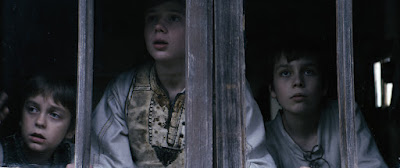

Based on the famous Ion Creangă’s fable comparable to the darkest of the Grimm Brothers’ fairy tales, ‘The Goat and Her Three Kids’ works quite smoothly as a blend of folk and home invasion horror leading to the revenge denouement, with human characters standing in for the anthropomorphic ones. Staying true to the (19th century) source material – a cautionary note on motherhood, (dis)obedient children and unscrupulous men, it appears even more terrifying, not only in what it shows, but also in what it suggests. Although both the protagonists and a villain remain archetypal, the nuanced performances, especially from seasoned actors Maia Morgenstern (mother) and Marius Bodochi (big, bad wolf), make them believable. Add to that a dense atmosphere of a remote forest setting, authentic production and costume design, moody cinematography and haunting score, and you have yourself a promising feature debut. Primarily working in front of the camera, Victor Canache directs the film with a steady hand, and makes the most of the economic running time, minimal cast and beautiful location.
14. I lunghi capelli della morte / The Long Hair of Death (Antonio Margheriti, 1964)


Released in the same year as ‘Castle of Blood’ (originally, Danza Macabra) also helmed by Margheriti, ‘The Long Hair of Death’ is an enjoyable, densely atmospheric gothic horror inspired by Mario Bava’s ‘Black Sunday’, with Barbara Steele’s strong screen presence challenged by that of Halina Zalewska, and Riccardo Pallottini’s gorgeous B&W cinematography keeping your eyes glued to the screen, in spite of the flawed narrative.
15. Das Phantom von Soho / The Phantom of Soho (Franz Josef Gottlieb, 1964)


A missing link between neo-noir and giallo, ‘The Phantom of Soho’ is one of numerous ‘krimi’ adaptations of Bryan Edgar Wallace’s novels, boasting some brilliant camerawork by Richard Angst, and tight editing by Walter Wiscchniewsky, with Martin Bötcher's sultry jazz score perfectly matched to the striptease club milieu. Violence is pretty tame when compared to the Italian murder mysteries, so no blood is shown in any of the stabbings, and killer’s glittering gloves don’t look as threatening as the leather ones, but the film is a solid chunk of pulp cinema nevertheless.