FEATURES
1. Nicht mehr fliehen / No More Fleeing (Herbert Vesely, 1955)

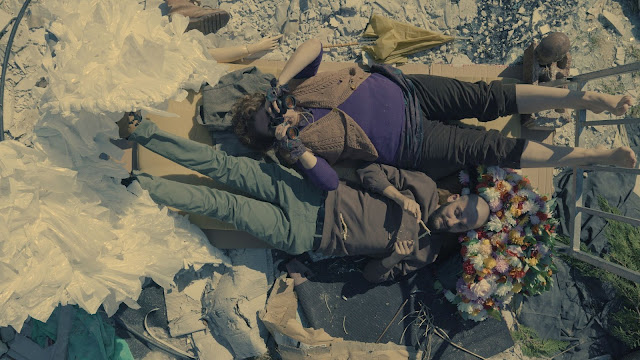
Possessed by the restless spirits of surrealism and early avant-garde, Herbert Vesely’s feature debut works as a crystal ball through which one can glimpse certain points in what was then the future of cinema. A post-apocalyptic meta-film, it precedes (and dare I say it, outshines) French New Wave offerings, and with its punkish attitude and absurd properties, foretells of the filmmakers such as Ulrike Ottinger, F.J. Ossang and Davide Manuli. There’s a strong de Chirico vibe to its desolate landscape setting in which sparse structures and objects throw elongated shadows, and an admirable attention paid to the frame composition, with the deliberate and inspired cacophony of both (jazz to ambient) music and (tricky) montages emphasizing the strangeness of visual juxtapositions. A few of the characters – lost and detached from ever-dissolving reality, and portrayed by non-professionals – act as nothing more than often silent ciphers in a doomy dream pervaded by the mood of ambiguity. A singular, visionary experiment deserving of a wider recognition!
2. Yōsō / Bronze Magician (Teinosuke Kinugasa, 1963)
The second to last offering from Teinosuke Kinugasa – the author of silent cult classic A Page of Madness (1926) – is a near-masterpiece of slow-burn cinema and is directed with unerring conviction. Part ‘historical fairy tale’ and part political drama, it revolves around a Buddhist priest, Dokyo (magnetically stoic Raizō Ichikawa) – both a messianic figure and a proto-communist, and his increasingly romantic relationship with the ailing Queen (Yukiko Fuji, solemnly gorgeous) against the backdrop of unscrupulous scheming of her ministers. Although the action takes place in the court, Bronze Magician is strikingly minimalist in its (irresistibly elegant!) production design, with the starkly beautiful B&W cinematography and rhythmical interplay of deep silences and ominously haunting score turning it into a ‘mystical noir’. As the purity of supernatural forces clashes with human wickedness, the ideas of equality fall through the generational gap and get buried under the slime of greed and pretense that ruling isn’t as simple as the (tragic) hero of the story imagines it.
3. Руслан и Людмила (Александр Птушко, 1972) / Ruslan and Ludmila (Aleksandr Ptushko, 1972)
One of the highest amongst high fantasies, Aleksandr Ptushko’s final film is a wondrous adaptation of his namesake Pushkin’s epic fairy tale chronicling brave knight Ruslan’s perilous mission to rescue the daughter of prince Vladimir, Ludmila, from the clutches of an evil wizard, Chernomor, who abducts her on the first wedding night. Lavish in production values and grandiose in scope,
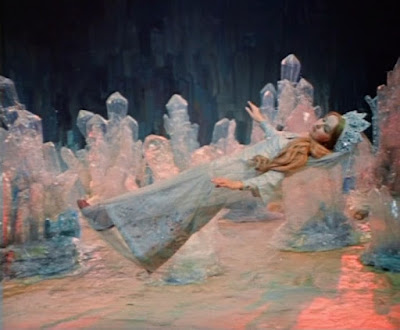
Ruslan and Ludmila is familiar in its simple and sincere account of romantic chivalry and magical interventions, yet it rarely loosens its firm grip on the viewer’s attention, bewitching you with its continuous stream of stunningly beautiful, larger-than-life imagery. Many of its shots appear as if lifted from the oeuvre of Russian illustrator Ivan Bilibin (1876-1942), with saturated colors piercing the darkness of an enchanted forest and flowers blooming in stop-motion after Ludmila’s release from Chernomor’s kingdom of coral and crystal gardens, chambers lit by upside-down fountains, and caverns whose walls and ceilings are supported by semi-nude, Titan-like figures. (The latter scenery brings to mind Mario Bava’s sword-and-sandal film
Hercules in the Haunted World which would make for a great companion piece to Ptushko’s swan song.) Underscoring its surreal, dreamlike qualities is a straightforward approach to the depiction of extreme violence which, albeit bloodless, doesn’t shy away from multiple decapitations and spear impalements in the heat of the battle, not to mention a traitor sliced in two by a court jester...
4. Breza / The Birch Tree (Ante Babaja, 1967)
It has always been difficult to be ‘a birch among beeches’, to quote the key line, especially in the Balkans where the ones who think or act differently are usually ridiculed, ostracized or silenced by the vocal majority. For gentle souls, the hardship is even more severe, and leads to their destruction. One such soul that belongs to a beauty, Janica, surrounded by beastly bumpkins including her burly husband, Marko, is in the center of a tragic, poignant story which satirizes the village life with all of its superstitions and hypocrisy, and reflects on the position of an artist in a society of ‘rugged’ mentality. Gorgeously capturing the exuberance of life and bleakness of death are Tomislav Pinter’s mesmerizing cinematography inspired by naïve paintings, and Anđelko Klobučar’s highly poetic and evocative score interspersed by traditional songs and heart-breaking lamentations of Janica’s mother.
5. Agatha et les lectures illimitées / Agatha and the Limitless Readings (Marguerite Duras, 1981)
“Her body’s indecency has all the magnificence of God. It’s as though the sound of the sea covers it with the sweetness of a deep wave.”
There is silent cinema and then, there is the cinema of deep, ruminative silences and soft, silently spoken words that – glacially absorbed by skillfully ‘painted’ negative spaces - put you in a peculiar sort of trance. As it breaks the ‘show don’t tell’ rule, Agatha and the Limitless Readings hypnotizes with its incredible formal discipline of long, largely static takes, and nostalgia-driven poetry written by both the rustling waves of the sea, and cold, autumnal light shrouded in the fond memories of summer. A most subtly told tale of incestuous love between a brother and a sister, this experimental drama ignites the viewer’s imagination through the verbalization of a forbidden romance, simultaneously dissolving the notion of time.
6. The Picture of Dorian Gray (Albert Lewin, 1945)
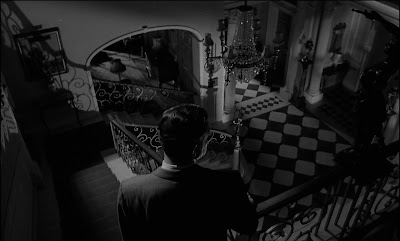
The epitome of (gothic) elegance, Albert Lewin’s adaptation of Oscar Wilde’s novel casts a spell over you by way of the highly expressive B&W cinematography, sumptuous production design, meticulous direction, and outstanding performances, particularly from George Sanders as cynical Lord Wotton, and Hurd Hatfield who brings to soulless life the titular anti-hero re-imagined as a cold, reserved and eerily mysterious character.
7. Beduino (Júlio Bressane, 2016)
A formally delirious, deliberately affected and amusingly absurd experiment in meta-filmmaking, with a couple of actors – Alessandra Negrini as ‘Surm’ and Fernando Eiras as ‘Beduino’ – enacting the search for ‘singular metaphysical desire’, as noted in the official synopsis, through dreamlike vignettes which take cues from the history of cinema. Quite possibly the one and only film that turns pickpocketing into a sexual act and features the burial of an ambitious cactus who deemed laughter as demonic, and was devoured by Zoo crocodiles under the cold moonlight.
8. Sei donne per l'assassino / Blood and Black Lace (Mario Bava, 1964)
If great lighting could kill, all the viewers would be dead during the very opening sequence.
9. Die seltsame Gräfin / The Strange Countess (Josef von Báky, 1961)
Klaus Kinski has his creepiness elevated to P. Lorre level in the supporting role of a psychiatric sanatorium escapee making threatening phone calls in a wonderfully pulptastic ‘krimi’ beautifully photographed in the best noir tradition, with the elements of humor typical of the genre significantly toned down in favor of heightened tension. Brigitte Grothum is great as a damsel-in-distress heroine, Margaret Reedle, who gets pushed down the spiral of madness by unenviable circumstances, and Joachim Fuchsberger saves the day as inspector Michael Dorn who uses pseudo-karate chops to incapacitate his opponents, and even manages to escape the straitjacket. The Strange Countess provides a perfect balance between artistically crafted visuals and twist-driven fun, making it a blast of a swan song for its author, Josef von Báky.
10. Sister, Sister (Bill Condon, 1987)
Jennifer Jason Leigh is utterly magnetic as the younger, gentler, more sensual, yet mentally unstable sister, Lucy, in Bill Condon’s intensely atmospheric debut which blends romantic / psychological melodrama, and Southern Gothic noir with the elements of erotic and supernatural thriller to immersive effect, as a shadowy Louisiana villa and the surrounding swamp which looks straight out of a horror flick act as characters in their own right. Opening with a brilliantly conceived dream sequence which sees sultry love making gradually transformed into a personal apocalypse, Sister, Sister may not be revelatory story-wise, because we have seen most of those twists emerging from the dark past countless times, but it is surely an aesthetic triumph, densely packed with beautifully moody visuals and accompanied by a suggestive score.
11. Saving Sally (Avid Liongoren, 2016)
A passion project 10 years in the making, Avid Liongoren’s feature debut is an unstoppable flood of visual inventiveness that more than compensates for by-the-numbers teen romance in the heart of the story, and somewhat shy, low key performances from the leading duo of Rhian Ramos and firsttimer Enzo Marcos. In order to show us the world from the (wildly imaginative) perspective of his nerdy hero the filmmaker goes for unapologetically quirky vibes of films such as Tears of the Black Tiger, Amélie, Eternal Sunshine of the Spotless Mind or Scott Pilgrim vs. the World, and seamlessly blends live-action with matte-painted backgrounds and retro-styled animation to a dazzling effect. Virtually every frame is brimful of details that often reflect mental and emotional states of the protagonists, as well as their unrestrained creativity and chaos they strive to control as they come of age.
12. Deux / Two (Werner Schroeter, 2002)
(read my short review HERE)
13. Gingakei / Galaxy (Masao Adachi, 1967)
A fine piece of Japanese avant-garde / underground cinema, Galaxy plays out like an experimental psycho-drama of a Möbius strip-like structure revolving around the identity quest, and following the dream logic. An unnamed protagonist’s bizarre journey into his subconscious involves multiple killings of his other self ‘from that time’, his girlfriend dressed in white, a demonic Shinto monk, queer undertones, and a series of morbid drawings intensifying the viewer’s bemusement. The film’s tinted, cleverly edited visuals coupled with a cacophonous score of jazzy improvisations and distorted voices enhance the atmosphere’s oneiric or rather, nightmarish quality.
14. This Island Earth (Joseph M. Newman & Jack Arnold, 1955)
Complemented by Rex Reason’s rich baritone, vivid colors and psychotronic effects pop out of the screen in a dreamlike fashion, laying out the foundation for campy sci-fi flicks such as Barbarella (1968) and Flash Gordon (1980). The film gets increasingly bizarre, with its third and most imaginative act compensating for the shortcomings of the first two.
15. Night of the Demon (Jacques Tourneur, 1957)
16. The Living Idol (Albert Lewin & René Cardona, 1957)
17. Laokoon & Söhne / Laocoon & Sons (Ulrike Ottinger & Tabea Blumenschein, 1975)
Taking cues from silent films and circus attractions, the first collaborative effort of Ulrike Ottinger & Tabea Blumenschein is a deliberately goofy ‘fairy tale’ of a ‘blonde magic’ sorceress, Esmeralda del Rio, and her continuous transformations, set in a mythical land of Laura Molloy inhabited only by women (as well as a few men in drag posing as women). Heavily drunk on life, permeated with a childlike abandon, and quite possibly shot with both of the authors’ tongues deeply planted in their cheeks, Laocoon & Sons brims with vivid DIY imagery in which deconstructed myths and twisted reality blend to produce some strange, utterly absurd magic. It is a punkish, ritualistic piece of gives-no-damn-for-rules cinema that proudly wears its exuberant weirdness on the sleeve.
18. Bible! (Wakefield Poole, 1974)
Biblical myths have never been sexier than in Wakefield Poole’s provocative, delightfully bawdy renditions which dance on the tightrope between art film and softcore pornography, with dialogue eschewed in favor of colorful, handsomely framed imagery and the classical music accompaniment. Opening with the tale of Adam and Eve – a sensual, proto-Blue Lagoon vignette shot among cavernous formations and on an exotic beach, the film throws an apple joke to continue with Bathsheba’s bath while Uriah (wearing a nipple-and-sixpack-revealing armor) is not at home (and King David turns into a Peeping Tom), only to take a mystical turn with somewhat Jodorowsky-esque take on the love affair of Samson and Delilah who look like young Tom Savini and Grace Jones, respectively. A short, dreamlike coda featuring Virgin Mary and Angel adds some extra fabric fluttering in the wind, until a neon-lit punchline puts a naughty smile on your face.
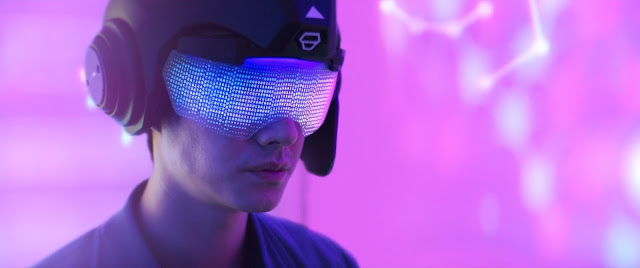
19. AI Love You (Stephan Zlotescu, 2022)
(read my short review
HERE)
20. ... a pozdravuji vlaštovky / And Give my Love to the Swallows (Jaromil Jireš, 1972)
SHORTS