A delirium of reality-dissolving non-sequiturs continues...


A junkyard of twice-broken dreams, disfigured thoughts and unfinished sentences, on the outskirts of the Unknown. The deliberate dissonance of images from the hyper-conscious mind of an unreliable narrator. Liquid identities, through the mirror, down the rabbit hole, ever-deeper...




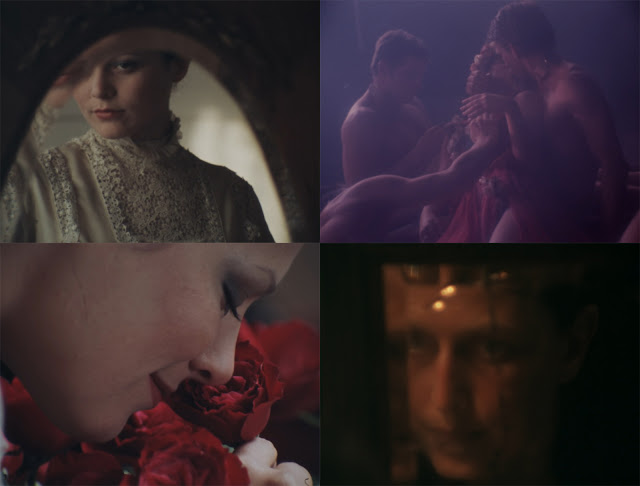
In his 1978 write-up for magazine ‘Take One’, Lawrence Weschler questions whether the film’s perspective is misogynist or, on the contrary, feminist, adding in conclusion that Chase comes “very close to the nerve of some highly vexing issues”. Personally, I find the titular heroine – in the bold, uninhibited portrayal by non-professional actress Elisa Leonelli – to be strangely innocent (must be the white dresses) in her playful sexual dominance over a plethora of male lovers, as well as over one female admirer, and that the problem lies within their desire to possess her and mold her as they please. Her seductiveness is a reflection of her ‘temporal displacement’, so to speak, and as such, poses as a huge thorn in the side of debilitated patriarchy rearing its psychopathic head in the tragically climactic, unnervingly tense and misleadingly calm epilogue.
The film is available at the author's official Vimeo channel, HERE.

Dubbed ‘lament’ by its homesick creator, and narrated in crackling voice-over that sounds as if recorded on a vintage dictaphone, this film essay erases the boundary between documentary and fiction, and washes over the viewer in waves of soul-stirring melancholy. Arising from the personal experience, it finds Mosese split into a peculiar trinity of alter-egos – a woman laden with a wooden cross, a frolicking trans-fairy that may embody (illusionary?) freedom, and already mentioned narrator weaving an intricate sonic elegy with her memory-fueled words. All the while, the long takes of longing, hand-held movements of confusion, extreme close-ups of intimacy, and freeze-frames of the desire for time to stop convey the unbreakable bond with one’s motherland, regardless of the masks worn and lies spoken...

Composed entirely of the fragments of (sadly) never-completed films found in the archives of Buenos Aires film museum, The Endless Film opens infinite possibilities of a narrative that may as well be missing. Its bold decontextualization becomes the very context, the imaginary plot mutating with every passing frame, and genre shifting from a murder mystery to a horror cartoon to a meandering tone poem to a memory of a period piece to whatever you want it to be, yet never quite is. The moody, thought-provoking assemblage of non-sequitur juxtapositions brings forth an autonomous entity that continuously collapses unto itself so that it could rise again, each time more puzzling than before. Both an illusion and its negation, it celebrates the spirit / quintessence of cinema in all of its enlightening absurdity, demanding active participation from the viewer, yet keeping you at a certain distance, torn between the states of complete immersion and compulsive alienation. Arguably remodernist, it seems to rest on Japanese ideas of wabi-sabi and mono no aware, firmly embracing its imperfections, and underlining its volatile meta-nature, neither beginning nor ending, flowing into a stupendous stasis, existing through a sort of a resistance in the aesthetic multitude.


“Love is a pond that can drown you.”
This one line perfectly summarizes the film in which ‘the most beautiful feeling in the world’ is depicted through the distorting prism of sickness, both physical and mental, that destroys the very notion of reality, bringing forth the personal one(s) of the two leading characters. Their traumatic past collides with the bleak, irretrievably twisted present, only to ensure the doomed future that neither of them deserves – could it be the only way for all gifted people? Portrayed with aching melancholy oft-disguised as uninhibited effervescence (Sophie Marceau) and the kind of mischief that only the lovesick are capable of (Jacques Dutronc), the star-crossed duo guides us through a decidedly disjointed narrative that goes to peculiar / surreal extremes in order to give a whole new meaning to the expression ‘emotional rollercoaster’. Even at his most gentle, the Polish enfant terrible directs at the height of creative madness, imbuing his romantic drama with burning (or rather, constantly rhyming) passion that turns sadness upside down...

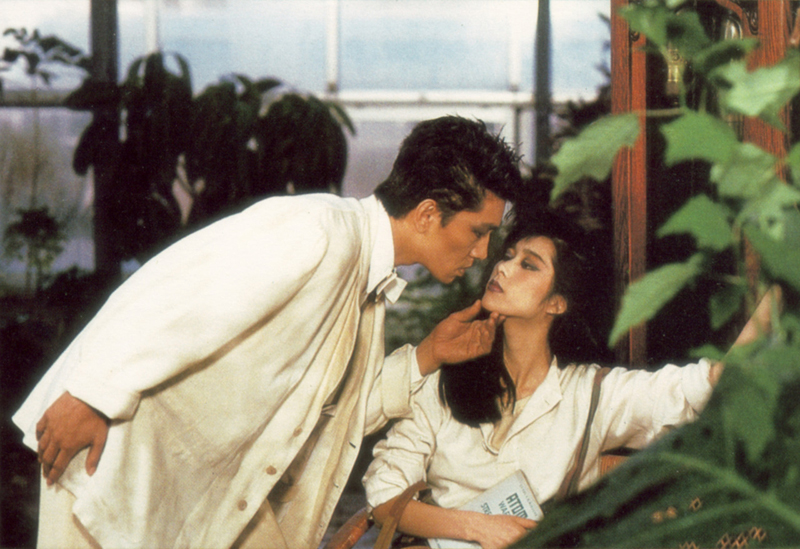

A picturesque proof that an educational film can also operate as a piece of high art, Miracle of Flowers is one of the earliest examples of using time-lapse cinematography in order to capture the pulse, rhythms and even state of mind of nature on screen. This ‘symphony of the life and death of flowers’ can be described as a dazzling botanical predecessor to Disney’s Fantasia. It sees various plants ‘performing’ to a sumptuous orchestral score, their mesmerizing dance-like movements married to choreographic interpretations by ballet artists of Berlin State Opera, with Maria Solveg portraying their guardian goddess Flora in the prologue. In his review, prolific film critic Fritz Olimsky astutely notes:
“This film offers deep insights into the psyche of plants, such as our greatest poets could hardly have dreamt of. It was a good idea to heighten the effect of this miracle of blossoms in a subtle way by means of first-class dances from our Staatsoper. And we should emphasize in particular how successfully the film develops these dances harmoniously out of the images of natural blossoming.”
12. Pevnost / The Fortress (Drahomíra Vihanová, 1994)

“Snakes are all around.”
Kafka would’ve had a field day with Drahomíra Vihanová’s sophomore feature released 25 years after her banned, yet masterful debut A Squandered Sunday (originally, Zabitá nedele, 1969). Set in an unspecified village near the titular fortress guarded by the army, the film depicts a meager existence of a 40-year-old intellectual, Evlad (superb performance from Hungarian actor György Cserhalmi), who lives in a trailer and is forced to measure water levels for the conspiring regime... Biting bitterness accumulated in the author’s soul is strongly felt in virtually every shot of this absurd drama, and in its oppressive atmosphere intensified by hand-held camera movements, as well as by alcohol-drenched, smoke-shrouded colloquies that channel totalitarian paranoia. Think something along the lines of ‘YU Black Wave meets Béla Tarr’s pessimism by way of Jakubisko’s mordant humor’ and you may get the idea of what to expect from a rather overwhelming viewing experience The Fortress provides you with.
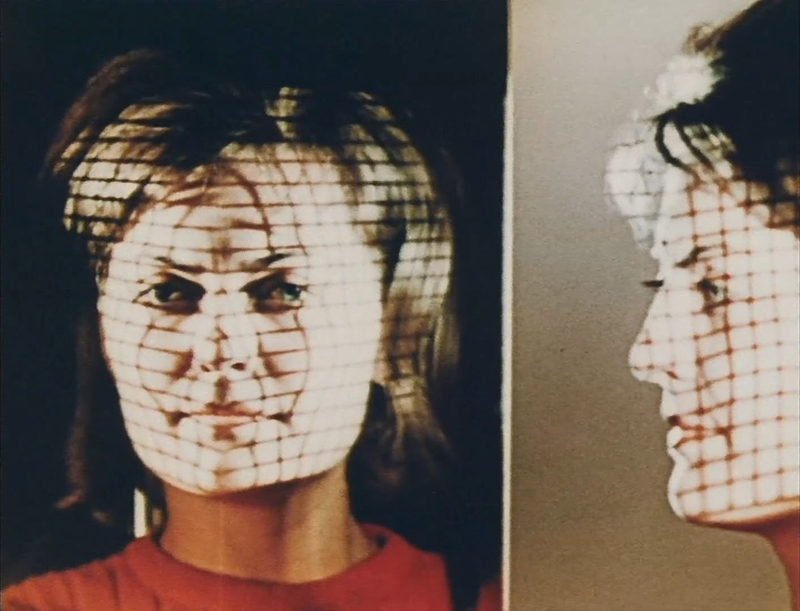


Oftentimes, I dream about being lost in an unknown city, trying to figure out my way to a bus station or the place of accommodation, though it happens that I get disoriented in familiar parts of my own hometown, as they’ve been reconstructed by my unconscious mind. These ‘mild nightmares’ leave me with a peculiar, not necessarily uncanny feeling of ‘wondrous displacement’, of simultaneously controlling and being controlled, as a dreamer and a dreamed one. Quite similar in its ‘oneiric value’ is the experience of watching (and being watched by) the first fiction feature from Argentinean filmmaker Leandro Listorti. (But, is that really fiction or a document of celluloid artifacts brought back to life?)
Composed entirely of the fragments of (sadly) never-completed films found in the archives of Buenos Aires film museum, ‘The Endless Film’ opens infinite possibilities of a narrative that may as well be missing. Its bold decontextualization becomes the very context, the imaginary plot mutating with every passing frame, and genre shifting from a murder mystery to a horror cartoon to a meandering tone poem to a memory of a period piece to whatever you want it to be, yet never quite is. The moody, thought-provoking assemblage of non-sequitur juxtapositions brings forth an autonomous entity that continuously collapses unto itself so that it could rise again, each time more puzzling than before. Both an illusion and its negation, it celebrates the spirit / quintessence of cinema in all of its enlightening absurdity, demanding active participation from the viewer, yet keeping you at a certain distance, torn between the states of complete immersion and compulsive alienation. Arguably remodernist, it seems to rest on Japanese ideas of wabi-sabi and mono no aware, firmly embracing its imperfections, and underlining its volatile meta-nature, neither beginning nor ending, flowing into a stupendous stasis, existing through a sort of a resistance in the aesthetic multitude.

Daj Bože – do gole kože
i kosti da se pozlate
prazna jaja i crv u oku
za gladnu stoku, za glupu stoku
pečena misao i sirova sisa
zadojila Isa
a ko je Is ako ne mali miš
bez ritualnog pliša
ne da se iz nedara lišaj
idi kao u smiraj i ćuti kao panj
što ne zna bez dna da
sutra biće juče
pa jauče li jauče
oblak sivi hrli ka njivi
a njoj se ne mili da spava
zaključala lava
u verziji iz ine dimenzije.

In the face of the crumbling world whose hostility is intensified by (petty) personal issues, looking back at the accomplishments in 2022 feels like a welcome relief, so I hope no one will mind me evoking the events that lent meaning to my collage art practice, as well as to my enthusiasm for films.

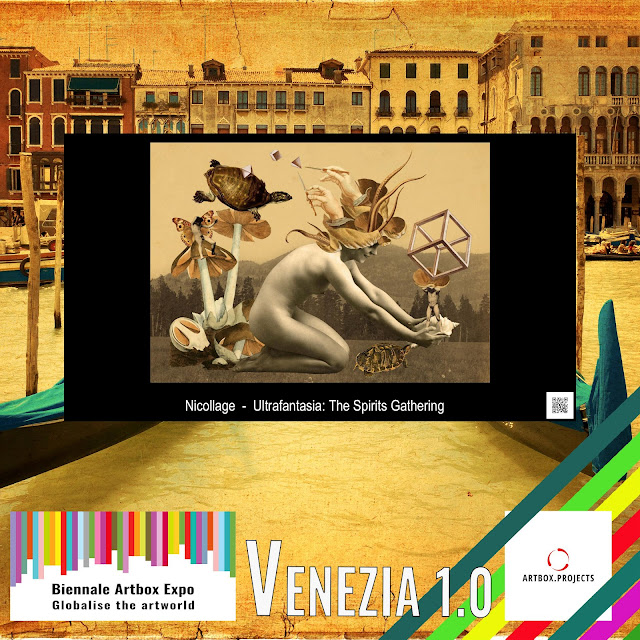
From March 24 to April 6, my fourth solo exhibition, ‘Hypnos II’, took place at the Gallery of the Center for Culture and Art Aleksinac, and it was wonderfully organized and curated. Two of the pieces hanging there as canvas prints – ‘La Perla’ (The Pearl) and ‘Il Regno (The Kingdom)’, both parts of the extensive ‘Bianco/Nero’ series – were selected by the creative committee of ARTBOX.PROJECT Venezia 1.0, and presented digitally at Tana Art Space in Venice, May 1 – May 31. Among 5 other collages that also reached ‘City of Bridges’, ‘Ultrafantasia: The Spirits Gathering’ was the most successful, winning the place among the 10 finalists, and being on display until the end of July.

‘I Pirati della Superluna’ (The Pirates of the Supermoon) was featured in Vol. 1 of the 50th issue of Artist Portfolio Magazine (in May), and earning a double spread in the 51st edition (October) were ‘A Graceful Apparition’ and ‘Herald's Reincarnation’. Summer and autumn were marked by three group exhibitions – ‘The Demigod of Ominous Silence’ and its counterpart ‘La Sensualité du Narcissisme’ animated by Martin Gerigk, at the Festival of Contemporary Collage Kaos (in Kranj, Slovenia, June 10 – August 13), ‘A Hazy Memory of Ariadna’s Song’ + ‘Labirinto a Cappella’ at Echo of Music (art colony in Negotin, Serbia, July/September) and finally, ‘The Last Fairy Tale’ + ‘A Landscape with Three Convergent Suns Dying Inside’ at Collage 2022 (online, John B. Aird Gallery, Toronto, October).

I was pretty excited to see my short debut ‘Untold’ on the big screen at the 69th edition of Belgrade Documentary and Short Film Festival that also premiered ‘Once I Passed’ – the second collaboration between composer / filmmaker Martin Gerigk and I, and being in the company of friends made the watching experience richer. The latter film was officially selected by nearly 100 festivals and shown all around the globe, winning a number of awards: Cinematic Achievement Award (Thessaloniki International Short Film Festival, Greece), Best Film (Feedback Animation Film & Screenplay Festival, Canada), Jury Special Award (FilmArte Festival, Germany), Best Short + Best Animation Film (Golden Harvest Film Festival, Japan), Best Experimental Film (Annual Tiburon International Film Festival, USA), Best International Experimental, Innovation & Creativity Award and Best Score (Canberra Short Film Festival, Australia), and the list doesn’t end here. Martin invited me to collaborate on another project – an audio-visual essay ‘Demi-Gods’ – which also received some accolades, from Honorable Mention at NFT | New Media | Experimental | Digital Arts Film Festival (England) to Best Experimental Film at Sipontum Arthouse International Film Festival (Italy) and Dubai Film Fest (UAE).

The Soviet avant-garde-inspired poster I designed for Martin Del Carpio’s upcoming short ‘Vuk: Murder in a Blue World’ was awarded ‘1st runner-up’ in the ‘Best Poster’ category at the fall edition of Alternative Film Festival (Canada), and got ‘Honorable Mention’ at the November edition of Best IFF organized by students and teachers from universities, colleges and schools from around the world.
‘Bianco/Nero’ was revived on a couple of occasions, to approach its 521st ‘chapter’, and three more collage series were born – ‘Acrostic’, ‘Les Fleurs du Mal’ and ‘Melancholia (Non) Grata’.

Energized by these precious memories, I wish you a year of good health, tons of luck, and perhaps, a miraculous utopian twist? Happy 2023!
